April 11, 2013
Historical Novelists’ 4 Day Book Fair April 12 – 15
Posted in Baroque Music, Historical Fiction, Novel, Reading, Virtual Book Fair, Writing tagged 17th Century, A House Near Luccoli, Alessandro Stradella, All Things That Matter Press, Composer, Historical Novelists, Kindle, NOOK, Romancing the Blog at 4:43 pm by bardessdmdenton
Welcome to my ‘table’ at the
and to
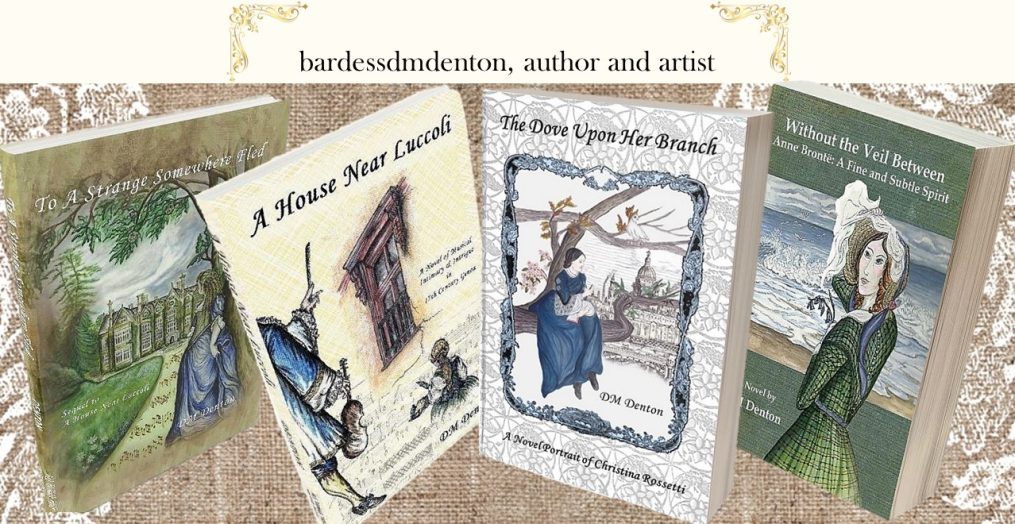
A House Near Luccoli
A House Near Luccoli focuses on chance encounters, beautiful music, and the paradox of genius through an imagined intimacy with one of the most legendary and undervalued figures of Italian Baroque music.
Published by All Things That Matter Press
Available at
Amazon.com
Barnesandnoble.com
in Paperback, Kindle, and NOOK Book editions.
Soon to be released as an audio book!
Over three years since the charismatic composer, violinist and singer Alessandro Stradella (1639 – 1682) sought refuge in the palaces and twisted alleys of Genoa, royally welcomed despite the alleged scandals and even crimes that forced him to flee from Rome, Venice, and Turin, his professional and personal life have begun to unravel again. He is offered, by the very man he is rumored to have wronged, a respectable if slightly shabby apartment and yet another chance to redeem his character and career. He moves in to the curiosity and consternation of his caretakers, also tenants, three women whose reputations are of concern only to themselves.
Donatella, still unmarried in her mid-thirties, is plainly irrelevant. Yet, like the city she lives in, there are hidden longings in her, propriety the rule, not cure, for what ails her. She cares more for her bedridden grandmother and cats than overbearing aunt, keeping house and tending to a small garden, painting flowers and waxing poetic in her journal.
At first, she in awe of and certain she will have little to do with Stradella. Slowly, his ego, playfulness, need of a copyist and camouflage involve her in an inspired and insidious world, exciting and heartbreaking as she is enlarged by his magnanimity and reduced by his missteps, forging a friendship that challenges how far she will go.
Excerpt from A House Near Luccoli:
It was a Sunday morning when she tried to return the folder with the copy included. Golone wouldn’t have it, leaving the house in a hurry. She might take advantage of Nubesta’s day off, as well, if Signor Stradella returned directly from whatever service his music attended while Despina napped after going to mass. Donatella trailed her aunt down small streets and across the square named for the closest church open to her faith even when she had none. For once she wished she wasn’t late. Santa Maria Maddalena was filled with music as sacred as its interior; a modest congregation settling amid its garlanded pillars and gilded moldings, nearer to heaven anticipated in the ceiling of the main altar. Her aunt looked for her to slide into their usual pew but Donatella’s skirt didn’t completely leave the aisle and she ignored a whispered objection more adamant as heads turned, putting herself forward as she never did except for communion.
It wasn’t her intention to be seen reverent in the ritual of silk and linen vestments and covers, golden chalice, paten and tall tapers, or kneeling nearer the graceful pain of the crucifixion, to be overheard less than fluent in echoes of Latin. She sat back and it was obvious why she was there: not for the usual madrigalists shielding the altar and taking direction from the pulpit, but an almost heretical performance in the small gilded gallery to her left, a stone rolled away, resurrection in the pleasured expression of strings and a man to whom every passion was necessary.
It wasn’t the place for bows except in prayer. Signor Stradella’s attention soon moved to the young lady by his side who had sung with sweetness, not strength.
On the way home one of the better houses was inviting. Despina sent her niece on, Donatella only minding the weight of her veil and skirt in the May shower that wasn’t unexpected either.
“Artemisia.”
She didn’t turn around.
By the time she hurried across the via Luccoli to face Saint George and the courage she lacked, the pavement was steaming and her resolve changing as quickly as the weather. Signor Stradella pushed the gate for her to go first, his rain-scented shrewdness surrounding her as he opened the front door.
“My aunt will be home soon.”
“Ah. We have a secret.” He slid his violin case from under his coat. At least they weren’t alone in the house, Cook singing without Despina there to mind, and Nonna calling. He tapped Donatella’s arm and asked how the assignment was coming along.
“It’s finished.”
“Bravissima. Let me see.”
“We could use the breakfast room.”
“Or less prudenza.”
Nonna just wanted to know she was back. “And Signore Stradella?”
“I haven’t seen him today.”
“I think you have.”
“Well, for a moment—”
“In the rain?”
“Oh. I should change.”
“No. You look as you must,” her grandmother smacked her lips, “caught off guard.”
Besides the folder of music, Donatella carried up a tray of limonata and anise cake, another of Nonna’s suggestions.
“At last.”
She smelled a candle burning, but it didn’t light the short hall. In the main room a window was open, with the settee moved closer to it, Signor Stradella a masterpiece resting there. One dark leg was stretched and falling over the back of the couch, a ruffled hand on its knee; the other bent to the floor and, even without stocking and shoe, appeared ready to walk away. He had also undressed to his shirt still buttoned high and wrinkled softly because it was made of the finest linen. A slight breeze blew his hair over his face. As he realized her burdened entrance, his right shoulder pillowed a half-smile and he reached out lazily.
“Did you bring bavareisa?”
“What’s that?” She clumsily laid the tray down on the gray marble hearth, not wanting to bend with her back to him.
“Cioccolata and caffè.”
“We don’t have coffee. It’s too expensive.”
“I’ll pay for it.” He swung into sitting, hunched and rubbing his neck. “I’m getting one of my headaches.”
“It’s the weather.” Donatella offered him a drink.
He accepted it, the tips of his fingers friendlier than they should have been. “A veil over the sun, like a woman at Messa.” He tasted it. “Ah. Fresco.”
“Squeezed this morning. Nonna says it’s good for clearing the voice.”
“Cara Nònna.” He raised his glass, then emptied it with a kiss on its rim. “I’ve heard she was very rebellious. I wonder you didn’t become the same.”
“I wasn’t meant to.”
“How do you know?”
“Because it didn’t happen.”
She was still holding the folder.
“I believe that’s why you’ve come?”
He moved slowly to make space on the table where his inventions were layered and sprawled, so many at once. By the time she placed the copy there he was sitting once more, leaning forward, his head in his hands.
“You can let me know.” She felt intrusive. “I’ve never seen you at Maddalena before.”
He rose, admitting his rudeness. “I was testing the sound for a wedding there.”
“It must be a special one.”
“Ah. I’ll make it so.” His teeth showed. “Così.” He leaned over the table, the side of his face long and angled, eyelashes still and mouth taut, the first page flipped for the second, the second for the third, every one after that as unremarkable.
“I’m untrained.”
He looked at the first page again, his index finger, chin, and muted hum following the stanzas. “Ah. You see. Just a little more space here and this note a little higher, the words not quite aligned.”
Her hope of impressing him was gone.
“No, no.” He showed sensitivity to being misunderstood. “Even my last copyist, a priest, cursed my sloppiness.”
“I did my best.”
“Ah. Anyway, there are many arie in the serenata, besides duetti and trii and sinfonie. I need copies of each by—you saw the date; barely a month away. Before that for rehearsal.” He closed the folder, falling back on the settee. “And only so-called musicisti in Genova, too quick or too slow or distracted by ambizione. Will you do more for me?”
She had to consider. His reputation. Her motivation. She couldn’t sign her name to the work, freely spend any payment, or even show some pride. Sneaking around, her aunt would eventually find out and put a stop to it anyway.
“Is that cake?”
“Yes.”
“For the flies?”
“Oh.” She rescued the plate.
He took a slice, eating it almost without chewing. “As we live dangerously opening windows.” He reached for another, nodding for her to take what was left.
“All right,” she answered.
“Bene allora.”
“I mean … I will help you.”
“Mangia.”
“Oh, yes.” She broke a corner of the last piece on the plate.
He got up to pour her a glass of limonata, staring as her lips, covered in crumbs, finally took a sip.
My Bio:
I am a native of Western New York State, where I currently reside. My writing life began as a child retreating into the stories and poems that came to me. Early on I developed an interest in history, especially European history, while myparticipation in and appreciation of music was encouraged through memories shared about my maternal grandmother, who was a concert pianist in Chicago in the 1920′s. Some of the most defining years of my adult life were while she was studying and living in rural England, in a yellow-stoned village with thatched cottages, a duck pond, and twelfth century church and abbey turned Jacobean manor house. In addition to writing, music, art, and cats, I am passionate about nurturing nature and a consciousness for a more compassionate, inclusive, and peaceful world.
A House Near Luccoli is my first published novel. I am currently working on a sequel set in late Restoration England, and have also published an illustrated poetry book, A Friendship with Flowers.
I recently did an interview with Unusual Historicals about the the writing of A House Near Luccoli and more.
I also invite you to visit my website: http://www.dmdenton-author-artist.com, where you can find more information on my publications, view her prose and poetry portfolio and artwork.
You can also find me on:
Facebook Twitter Goodreads Library Thing Pinterest Lulu Google Plus
Thank you to Francine Howarth for hosting this virtual book fair.
I encourage you to go to Romancing the Blog
where you will find links to the sites of all the other authors who are participating.
Have fun browsing the fair!
©Artwork and writing, unless otherwise indicated, are the property of Diane M Denton. Please request permission to reproduce or post elsewhere with a link back to bardessdmdenton. Thank you.
Rate this:
April 7, 2013
My Guest Spot on Unusual Historicals
Posted in Baroque Music, Fiction, Historical Fiction, Music, Novel, Publishing, Reading, Writing tagged A House Near Luccoli, Alessandro Stradella, All Things That Matter Press, Author Interview, Carolyn Gianturco, Excerpt Thursday, giveaway copy, Guest Spot, Unusual Historicals at 4:30 pm by bardessdmdenton
Another post from me in record time! But I offer something I hope you will enjoy, including the chance for a giveaway copy of my novel, A House Near Luccoli!
Last week and this I have been featured on Unusual Historicals, a blog which regularly showcases historical fiction authors who ‘brave the wilds of unusual settings and
times to create distinctive, exciting novels just outside of the mainstream.’
On Thursday, the site featured a blurb about my novel as well as an excerpt – one that I haven’t posted before: Excerpt Thursday: A House Near Luccoli by DM Denton
Today, Unusual Historicals features an interview with me regarding the novel and more. Thanks to Lauren Scott, Christine Moran, Ina Schroders-Zeeders, Kim Zollman Rendfeld, Angela Nevitt, and M.M. Bennett for their excellent questions.
Drawn from among them, the winner of a free Kindle or NOOK Book copy of the novel is M.M. Bennett!
There’s another opportunity to win a free copy (in whatever format – Paperback, Kindle or NOOK Book edition - that works best for you). But you must visit Unusual Historicals and leave a comment (brief or otherwise) on the post containing my interview (remember, e-books can be given as gifts!). While you are there, check out other guest author posts. It’s a great site!
Unusual Historicals Q & A with DM Denton:
When and how were you first introduced to Alessandro Stradella?
I first heard Stradella’s story and—knowingly—his music while driving to work in 2002 and listening to a Canadian classical music radio station show called In the Shadows. By the time I arrived at work, I could only remember his first name! Don’t tell my former boss but as soon as my computer booted up I Googled composers named Alessandro, scrolling down all the entries for Scarlatti to finally find a few mentions of … Alessandro … Stradella!
In time I found out why Stradella—a celebrity in his time who produced a body of work that set him alongside the greatest Baroque masters—was, at best, a footnote in music history. Unfortunately, in the decades and centuries after his death, Stradella’s alluring ‘story’ took on an almost exclusively cloak-and-dagger slant in novels and operas, eclipsing his importance as a composer until his music was rarely performed. Only recently, thanks to a dedicated biographer and cataloger and some enlightened musicians, has that begun to change. In fact, I just discovered that Stradella’s “Sonata in D Major for Trumpet and Strings” was included in the soundtrack for the movie, The Girl with the Dragon Tattoo.
How did your interest in Alessandro Stradella grow to the point of wanting to write about him?
From the first, I was drawn to him because of the contradiction between the discipline of his work and recklessness of his behavior. It evoked a special connection for me, for I had personally seen the potential of talent and purpose sabotaged by incautious, even self-destructive behavior. The more I learned about Stradella’s triumphs and failures, and all the hard work and missteps in-between, the more I became fascinated by a personality at once charming and creative, intelligent and indulgent, cultivated and itinerant—an adventurer who made a few messes but also many masterpieces along the way.
Finally, in the summer of 2005, I really met Stradella in the intimacy my imagination created: observing him behind the scenes in great and small ways, surrendering to his charisma, and enjoying his self-determination while exploring why he so often put his career and life at risk. I often thought how much easier it would have been if there were more details available about his appearance, personality and the events of his life, but I also realized his obscurity offered an opportunity to discover him in less public ways: through his letters, even his handwriting, and especially his music that knew the ‘rules’ but pushed the boundaries.
Is the house near Luccoli of the novel’s title an actual residence?
There is the possibility that the last place Stradella lived in Genoa was a house near the Luccoli district. The house was most likely owned by Guiseppe Maria Garibaldi, one of the Genoese noblemen who supported Stradella. I couldn’t find any specific details regarding this house—such as its exact location or whether it still existed—but for the purpose of the novel put it on the map and set to ‘building it’ based on what my research and imagination came up with. I knew from the beginning that I wanted to create a domestic setting for the meeting and developing relationship between Donatella, my fictional female protagonist, and Stradella; one that allowed the reader behind the scenes of his career and persona. The novel does, at times, escape such close quarters into the magnificence and mayhem of Genoa; but, I think, essentially remains an interior study of character and circumstance.

What surprised you the most in your research for the novel?
One of the most surprising things was discovering Genoa as a fascinating place and perfect setting for the story I wanted to write. Up until then I knew it as Christopher Columbus’ birthplace, otherwise—if most travelogues of Italy were anything to go by—for passing through on the way to somewhere else or avoiding altogether. La Superba (The Superb One) is a vertical city, back-dropped by the Apennine Mountains, surrounding a bay looking out past its famous Lanterna (lighthouse) and the Ligurian Sea towards the eastern Mediterranean. It has splendid churches, palaces and villas; but, also, in its medieval center, a labyrinth of narrow caruggi (alleyways) full of poverty, danger and sudden beautiful entrances to half-hidden palazzi. It is a conflicted place with, as Stradella’s chief biographer, Carolyn Gianturco, wrote, “a climate of public puritanism and private crime.” The novel is about human contradictions, too: Stradella’s, of course, but also Donatella’s. Genoa has been called “the most English city in Italy”, and so proved an apt location as Donatella is a ‘daughter’ of both countries.
Were you tempted to write yourself into any of the characters?
I was more than tempted. I knew I was there from the opening lines, disguised and revealed in the character of Donatella. Like me, she is Italian and English, a writer and artist, gardener, companioned by cats, wrapped up in solitude, contradictions, moods, and memories, and addicted to music’s presence in her life. Certainly, I could understand her struggle with surrendering to Stradella’s charm, talent and impetuosity; how it felt to be amazed, flattered and bewildered by such an attraction; and that in the end so much and so little changed for her through knowing him. This was a very personal story for me to write. Even more so once it was published, life imitating art when Donatella’s quiet grief and onward journey became my reality, too.
How did you write about music and are you a musician yourself?
I knew the most important thing to do was listen—constantly listen, Stradella’s music a soundtrack to the conceptualizing, researching, and writing of the novel until I was living with and even haunted by it like an invisible presence. Of course, I did refer to academic sources, and the notes on CD sleeves were also a great help. I used some musical terminology as it offered imagery the poet in me found too lovely to resist!
I have played the piano, guitar and Celtic harp, and sung a little. The pleasure I find in trying to translate music into words might come from my regret at not having pursued a musical career. I suppose writing about music is another way of participating in it. I found it very satisfying. I never set out to try to imitate, explain or even describe music, but somehow convey its elusive existence in the heart and spirit.
This question makes me think of the 1991 French movie about the 17th century composers Marin Marais and Sainte-Colombe, Tous les Matin du Monde that asks: “What is music?” Sainte-Colombe insists words cannot describe it—that it is the sound of the wind, a painter’s brush, wine pouring into a cup, or just the tear on a cheek. I agree that it is impossible to express the essence or the effect of music in words, but I hope my readers experience something of its beauty and power through what I have written, especially as it is inexpressible.
How long did it take you to find a publisher for the novel, and what are you currently working on?
From completion to publication of A House Near Luccoli took about four years. Initially, I had submitted to literary agents for a year or so, but—perhaps sooner than I should have—gave up; except for creating a website which was eventually noticed by the novelist Mariana Julia Neary who was influential in my signing with All Things That Matter Press. My affiliation with this small publisher has proved to be one of the best things that has ever happened to me, not only because of their willingness to publish the novel, helping me to make it the best it could be while honoring its vision and voice even to the extent of using my own artwork and design for the cover; but also because of the dedication and ongoing patience and encouragement they extend to all their authors.
I am currently working on a sequel to A House Near Luccoli which I hope to have completed by late spring or early summer. I continue to write poetry and small prose pieces accompanied by artwork for my blog, and have just published an illustrated poetry journal entitled, A Friendship with Flowers.
Thank you for taking the time to read and hope you have put your word in over at Unusual Historicals for the giveaway!
Rate this:
April 3, 2013
Announcing A Birthday and Book Fair
Posted in Baroque Music, Fiction, Historical Fiction, Music, Novel, Reading, Writing tagged A House Near Luccoli, Alessandro Stradella, All Things That Matter Press, Birthday, Composer, Kindle, NOOK, Romancing the Blog, Virtual Book Fair at 4:13 pm by bardessdmdenton
Happy Birthday
Alessandro Stradella
extraordinary Baroque Composer
born April 3, 1639
Before her was a gracious creature, especially his hands composing in mid-air and eyes shifting slowly in observation and expression. His hair was an admission of the recklessness that got him in trouble, the vagrancy of his genius making him too accessible. Without music’s influence he might not wander like a prince among his subjects, although who could think that was all there was to him?
From A House Near Luccoli by DM Denton
Here are some more upcoming dates to note:
April 12 -15
My novel, A House Near Luccoli, published by All Things That Matter Press, will have ‘a table’ there. At this time 36 novelists have signed up to participate!
This book fair is graciously hosted by Francine Howarth at Romancing the Blog and is for authors and readers who ‘love stepping back in time’. I encourage you to ‘attend’ between April 12th and 15th to tour the blogs of its participants.
If you are an author who would like to sign up, you can still do so on Francine’s blog.
You can be sure that I will be reminding everyone about this virtual book fair nearer the time. And watch this space for the winner - from among those who submitted excellent questions for my upcoming interview with Unusual Historicals - of a kindle or NOOK Book edition of my novel!
For now, let the celebrations begin!
“In the bay there was no limit to Genovese showing off, shared with every curious civilian like the sunset painting a backdrop to the parade shaping the porto out as far as the Lanterna and back to where most … weren’t welcomed aboard the hall of barges. The construction was at first as impressive as its company in silk and ornaments and flowers, soon too warm for fashionable wigs and not seaworthy for heels and top heavy trestles of food. Large layered skirts concealed the spread of feet, made-up faces masked any nausea while gloves refined the drinking and fanning that could have been seen as coarse and flirtatious. So it wasn’t just the floating hall that swayed the signori familiarly close to the belle signore they did and didn’t apologize to.
“The flat boats rocked, the guests wouldn’t be seated, and everyone and everything sweated. For one reason and another, the servers were frustrated and most attentive to swarms of flies landing on the festa. It was a ridiculous evening.
“Then my musica began. A mixture of harmonious voices, poetry and fine instrumentalists,” Signor Stradella read from his palms, “a signor importante wrote.”
From A House Near Luccoli by DM Denton
©Artwork and writing, unless otherwise indicated, are the property of Diane M Denton. Please request permission to reproduce or post elsewhere with a link back to bardessdmdenton. Thank you.
Rate this:
March 15, 2013
What Would You Like to Know?
Posted in Art, Baroque Music, Love, Music, Novel, Reading, Writing tagged 17th Century, A House Near Luccoli, Alessandro Stradella, All Things That Matter Press, Author Interview, Composer, Copyist, Genoa, Kindle, NOOK Book, Unusual Historicals at 5:20 pm by bardessdmdenton
This post is a little different for me, but I am hoping some of you might be able to help.
Regarding my novel, A House Near Luccoli published by All Things That Matter Press: I will be doing an interview in early April for Unusual Historicals, a blog where historical authors brave the wilds of unusual settings and times to create distinctive, exciting novels just outside of the mainstream.
For those who don’t know, the novel imagines a fictional intimacy with one of the most legendary and yet obscure composers of the 17th century, Alessandro Stradella. Set in Genoa where Stradella seems to have made a new start after being involved in scandals that forced him to flee Rome, Venice and Turin, his professional and personal life have begun to unravel once more. The novel begins as he moves into a new apartment to the curiosity and consternation of its caretakers. At first, one of them, Donatella, is in awe of and certain she will have little to do with Stradella. Slowly, his ego, playfulness, need of a copyist and camouflage involve her in an inspired and insidious world, exciting and heartbreaking as she is enlarged by his magnanimity and reduced by his missteps, forging a friendship that challenges how far she will go.
Of course, if you have read the novel or are reading it, I would love to know what you would like to know about it.
Even if you haven’t read it, I would greatly appreciate any suggestions on the kind of questions you might like to ask an author about their work specifically or generally or otherwise. (You can read more about the novel at its page on my website.)
Just put any suggestions in a comment to this post. All those who do offer interview questions will go into a draw for a free Kindle or NOOK Book edition of the novel. (If you already have a copy, it would make a great gift!)
I look forward to your ideas! Thank you in advance.
PS: Likes, Ratings, and Reviews are always welcomed, whether on amazon.com, barnesandnoble, Goodreads, or all three – and don’t forget my Facebook Author Page! (I am always willing to return the favor.)
©Artwork and writing, unless otherwise indicated, are the property of Diane M Denton. Please request permission to reproduce or post elsewhere with a link back to bardessdmdenton. Thank you.
Rate this:
March 7, 2013
Nerdy Girl and Rock Star – 17th Century Genoese Style
Posted in Fiction, Historical Fiction, Novel, Publishing, Review, Writing tagged 17th Century, A House Near Luccoli, Alessandro Stradella, Cat Lady, Classical Musician, Composers, Genoa, Marina Julia Neary, Music History, Nerdy Girl, Picaresque novel, Self-destructive Rock Star at 6:03 pm by bardessdmdenton
New Five Star Review of A House Near Luccoli
by Marina Julia Neary
Imagine a nerdy cat lady and a rakish, self-destructive rock star. Now throw
this scenario back to 17th century Genoa, and you get “A House Near Luccoli”.
Music history is filled with stories of composers who were dismissed by their
contemporaries only to be rediscovered deified decades, sometimes centuries
later. Alessandro Stradella’s story is the opposite. He was quite an emblem in
his day and had since faded into relative obscurity. My mother is a classical
musician, and when I asked her about Stradella’s status in the musical pantheon,
she looked puzzled. “He doesn’t get played much these days”, she said. For this
very reason I applaud the author, DM Denton for pulling this composer from
obscurity. His personal life makes for a great plot for a picaresque novel. And
yet, “A House Near Luccoli” is not a traditional picaresque. It’s a
psychologically authentic study of ambition, polarization of gender roles in a
Catholic country, where men, especially those endowed with musical talent, were
excused from the conventions imposed upon women. It’s about the position of a
star in the society and the perilous liberties it implies.
I owe much to finally being a published author to Marina. She is an accomplished writer, exhibiting edgy wit, sublime intelligence, and an engaging sense of theater! You can check out her work here.
See my review of her novel, Martyrs and Traitors, A Tale of 1916 about another obscure figure in history, Bulmer Hopson, a misunderstood antihero involved in the ill-fated Irish Easter rebellion.
And more happy news: A House Near Luccoli is now in production to be an audio book which should be available mid-April. Thanks to Deb and Phil, my lovely publishers for believing in me and submitting to ACX (Audiobook Creation Exchange)! It will be available through amazon, audible.com, and iTunes.
©Artwork and writing, unless otherwise indicated, are the property of Diane M Denton. Please request permission to reproduce or post elsewhere with a link back to bardessdmdenton. Thank you.
Rate this:
February 5, 2013
A House Near Luccoli by D.M. Denton | Review | Historical Novels Review
Posted in Baroque Music, Historical Fiction, Music, Novel, Publishing, Reading, Review, Writing tagged A House Near Luccoli, Alessandro Stradella, All Things That Matter Press, Composer, DM Denton, Genoa, Historical Novel Review, Historical Novel Society at 8:58 pm by bardessdmdenton
Historical Novel Society Review of my novel, A House Near Luccoli
Published by All Thing That Matter Press
A House Near Luccoli by D.M. Denton | Review | Historical Novels Review.
The remarkable Baroque composer Alessandro Stradella stands at the center of Denton’s bright, sparkling novel A House Near Luccoli. Unmarried, mid-thirties Genoan woman Donatella encounters the volatile, slightly disreputable genius and at first is appalled by his manners and eccentric ways, but she and others are also gradually taken by his undeniable charm.
Denton is an unapologetically enthusiastic writer (exclamation points abound), imbuing even her minor secondary characters with three-dimensional life. Her research into all aspects of the period is thorough but not wooden; this is foremost a book of characters and character-study, ultimately in many ways a book about how friendships form. Stradella’s life came to a very abrupt end, and this book does too, a bit – but it’s all immensely enjoyable just the same. Highly recommended.
Stephen Donoghue
I invite you to read additional reviews
and
more about the novel.
As always, thank you so much for your visit!
©Artwork and writing, unless otherwise indicated, are the property of Diane M Denton. Please request permission to reproduce or post elsewhere with a link back to bardessdmdenton. Thank you.
Rate this:
December 30, 2012
Words and Music
Posted in Baroque Music, Fiction, Historical Fiction, Music, Novel, Writing tagged A House Near Luccoli, Alessandro Stradella, Batavia Daily News, DM Denton, Henry Purcell, Italian, Nancy Argenta, Oxfordshire, Roger North, Wroxton at 3:41 pm by bardessdmdenton
I am listening to The Plaint: O Let Me Weep by Henry Purcell (1659 – 1695), playing it over and over, a mantra while I’m writing. Even vocal music doesn’t distract me if it’s fluid and expressive, like the current under a boat, sending a narrative on its way. In the liner notes of soprano Nancy Argenta’s Songs and Airs CD, Adelaide de Place writes that “Purcell liked to compare music and poetry with two mutually supportive sisters.” The 17th century Italian composer, Alessandro Stradella (1639 – 1682), the focus of my novel, A House Near Luccoli would’ve appreciated the comparison, perhaps smiling mischievously, preferring to create a little rivalry. Never discord. Even his Italian “sisters” would have bowed gracefully to his designs, side by side, arms entwined, differences reconciled as their voices blended into one sound so beautiful no man could put asunder.
English lawyer, biographer and “Renaissance man” Roger North (1653 – 1754), who figures prominently in the sequel to A House Near Luccoli, wrote that “poetry called” his grandfather, the 1st Lord North, “to music.” For me it was the other way around, music expressing almost everything I couldn’t until I picked up a pen like a violinist lifts his bow and interpreted it into something so personal, beyond thought and emotion. Without music I may never have written a word, never realized I had to write, never lost track of time until I found myself alone in its company having forgotten how to speak – except silently.
Both words and music are about playing with silence, like birdsong or breezes or rain or thunder, our breathing or someone else’s, heartbeats and heartaches, love-affairs and loneliness. As with the chicken and the egg, their collaboration employs a circular cause and consequence, no way and no need to answer the question of which came first or is more important. As music inspires me to write, I desire to make music of my writing.
As I write now I am thinking of ghosts and not minding the melancholy, for it sounds so pleasing I question there is anything more joyful. It’s as if I’m enveloped in a prayer. O let me weep … or smile … or dream … or despair as I please; let me never be at a loss for words and music. Amen.
The above is a repost from July 2011, the early days of my blog.
Although I knew the following article about my authorship of A House Near Luccoli was going to appear in a local newspaper, I was astonished by the beautiful layout. I share it here and greatly appreciate you taking the time to read:
A Literary Note
Batavia Daily News
December 15, 2012
EAST PEMBROKE – The first time Diane Denton heard the music of Alessandro Stradella, she knew she was listening to something extraordinary.
She didn’t realize as she drove to work at a media consultant firm that morning in 2002 just how big an impression it would make on her life, or that she would spend years researching the artist and another three years writing a book about him.
A fan of the classics, Denton was listening to CBC Radio 2. The show, In the Shadows, highlighted the lives and works of artists – mainly musical – who for a variety of reasons had been largely ignored or forgotten.
“On this particular morning, a 17th century Italian composer, whom I and obviously many others had never heard of, was featured,” Denton said. “His music was stunning — fluid and melodic, with clear expressive vocals and distinct instrumentations.
“Set in 17th century Genoa, Italy, A House Near Luccoli is the story of the little-known, but brilliant 17th century composer named Alessandro Stradella. She described his story as “replete with romance and intrigue, triumphs and tragedy, like an opera drawing on the divinity and failings of gods and men.”
“The fictional Donatella in the book is a lot of me, although it wasn’t a conscious thing while I was writing the novel,” said Denton, who lives with her mother in East Pembroke. “I did want to express a point of view of a woman who is very self-contained, but rather insecure, perhaps too sensitive, artistic and talented, but who unvalues her life in a resigned sort of way. Donatella was a fictional female protagonist stepping out of my own hopes and disappointments.”
Denton said she has been writing since she was 12, but her mother remembers the first poem Denton wrote for Thanksgiving when she was only 6 – about a family Thanksgiving gathering and being grateful their family was all together.
Denton was born in Buffalo and grew up in Tonawanda. During her junior year, she studied in England, where she met a young man, married and stayed for 16 years.
“I lived, for better or worse, right off the pages of Fielding, the Brontes, Austin, Hardy, DH Lawrence and even Dickens, surrounded by the beautiful hills, woods and fields of the Oxfordshire countryside,” Denton said.
In the meantime, her parents moved to East Pembroke, where Denton returned after her father Carmen died in 1986.
Although she has always been interested in history, particularly European history, Denton said her participation in and appreciation of music was encouraged through memories shared about her maternal grandmother Marion DiCesare (ne Allers), who was a concert pianist in Chicago.
Denton also shares artistic talent with her mother, and their paintings hang side by side on the walls of their home. Denton did the illustrations for A House Near Luccoli herself.
One reason Denton was intrigued with Stradella’s music is because his story reminded her of a modern-day musician she knew who, in many ways, sabotaged himself and the potential he could have achieved.
“By the time I pulled into the parking lot at work, I knew why I was listening,” Denton said. “I ‘knew’ Alessandro Stradella. I recognized his distinct voice, his swaying form, his infectious smile and his wandering heart.”
Denton spent the rest of that morning and many more hours in pursuit of Stradella. She said her writer’s urge “to do something with him” was easier stirred than accomplished. There was so little about him on the pages of Google searches and music histories, Denton’s desire to create something out of her interest in the man was soon frustrated and abandoned.
It wasn’t until 2005 Denton returned to her work on Stradella.
“The timing must have been right, for suddenly resources, although still not in abundance, were easier to find,” she said. “As I read my costly copy of Alessandro Stradella, the Man and his Music by musicologist Carolyn Gianturco, I found an opportunity for imagining my way into his story, focusing on his last fateful days in Genoa.”
Her intention, Denton said, was not to change history, but quietly humanize it; not merely to appreciate a great musician, but personalize him; to reveal the ordinary in the extraordinary and the significance of the insignificant.
The title and main setting of Denton’s novel reflect the strong possibility Stradella last lived in a house owned by Giuseppe Maria Garibaldi, just off the via Luccoli in Genoa. Records indicated this was where his possessions were inventoried after his tragic and untimely death in his 40s.
Although talented and cultivated, Stradella was something of a vagabound and messed up many opportunities to become rich and famous. He had a reputation for making messes, but also masterpieces, Denton said.
Copies of A House Near Luccoli are available at Present Tense Books, 101 Washington Ave., Batavia (NY); The Book Shoppe in Medina (NY); and online at amazon.com in paperback and Kindle edition, and at barnesandnoble.com as a NOOK book.
Denton already has two more works in progress. She has been asked to write a sequel to A House Near Luccoli, which she hopes to have completed in late spring. The sequel will take Donatella to England and the small but stately Oxfordshire village of Wroxton, where she hopes to settle with her Italian mother and English father, a retired seaman.
“Another thing about my Donatella connection is, I am also of Italian and English heritage,” Denton said. “So I have lived a long time with the personality contrasts, even the struggles that come with that combination.”
Another work is a book of poetry based on journals she kept about the flowers and gardens in England and their changes through the seasons. That book is expected to be released in early spring.
Article written by Batavia News Correspondent, Virgina Kropf
©Artwork and writing, unless otherwise indicated, are the property of Diane M Denton. Please request permission to reproduce or post elsewhere with a link back to bardessdmdenton. Thank you.
Rate this:
November 20, 2012
New Review
Posted in Fiction, Music, Novel, Reading, Review, Writing tagged 17th Century, A House Near Luccoli, Alessandro Stradella, Baroque Music, Early Music Festival, Genoa Italy, Historical Fiction, Lyrical Prose at 3:28 pm by bardessdmdenton
I know … yet another self-promotion. But I had to share this beautifully written and satisfying review of A House Near Luccoli on Goodreads by Barbara Rodgers.
Review of
A House Near Luccoli
November 11, 2012
“She might have found comfort in making the most of it, like her cats sharing the day’s last sunlight, one small splash from the sea’s horizon to the edge of the carpet’s shore.”
A House Near Luccoli is full of such lovely and lyrical prose which gently transports the reader to 17th century Genoa, Italy. Taking in the author’s wonderful words, one can almost smell the gardens and sachets, taste the food and wine, feel the summer heat, see the musical notes being carefully transcribed, the sunshine glittering on the ocean, and hear the exquisite music. About a year ago we went to a concert, The Passion of the Italian Baroque, at the Amherst Early Music Festival, and heard beautiful performances with various combinations of the viol, violin, violone, recorder, flute, two oboes, cello, and three harpsichords. And a soprano sang along on a couple of pieces. Memories of the sound of that baroque music made reading the story of the colorful composer Alessandro Stradella and the restless Donatella all the more vivid in my mind.
Thank you, Barbara!
Please visit Barbara’s beautiful blog, “By the Sea’.
Rate this:
November 18, 2012
The Ordinary Meets the Extraordinary in A House Near Luccoli
Posted in Art, Fiction, Historical Fiction, Music, Novel, Reading, Writing tagged 17th Century, A House Near Luccoli, Alessandro Stradella, All Things That Matter Press, Baroque, Extraordinary, Genoa, Kindle, Ordinary, Royalty Free Fiction at 9:08 pm by bardessdmdenton
I love the stories in history that wait patiently to be lifted out of the shadows, offering room for the imagination to balance between the known and unknown; stories that are fresh and fascinating, about someone or something obscurely rooted in the past which, with attention and nourishment, might grow and blossom into enlightening entertainment for the present.
Read more of the inspiration behind my novel, A House Near Luccoli, published by All Things That Matter Press, at Royalty Free Fiction.
I was excited to come across this wonderful site (Royalty Free Fiction), created by author Deborah Swift, that showcases Historical Fiction free of kings and queens. And very pleased when Deborah generously agree to feature my novel, A House Near Luccoli. Instead of posting blurbs, plot synopses or reviews of the novels she includes, she asks authors to describe how they were prompted to write the stories they did, what excited them about the characters and settings, and something of the processes that brought their novels to life.
Deborah herself has written two fascinating novels: The Lady’s Slipper and The Gilded Lily (the latter soon to be released), published by Pan Macmillan(UK) and St Martin’s Press(US), with a third in the works: A Divided Inheritance.
As she correctly states: ‘history is full of ordinary people with extraordinary stories’. My novel A House Near Luccoli was born of this belief, especially in consideration of how all manner of stories and the persons within them intersect and affect each other. This is true of the present as well as the past, of course, and what also appeals to me is the timeless quality of these narratives – to quote a line from D. Bennison’s beautiful review of my novel – ‘addressing questions that are as relevant today’. In my opinion, history is most interesting and affecting when it is small and surprising, lurking in the untold, barely breathing behind the scenes of all that is so much talked and written about - in terms of its fictionalization: a kind of aphrodisiac for the imagination as well as the search for truth.

Thank you to all the writers, readers, supporters and promoters of Historical (and all genres of) Fiction that explores and honors the fine line between the ordinary and extraordinary! For those of you who are probably more than a little weary of my marketing efforts, I apologize. But through patience and persistence I hope the word will spread that A House Near Luccoli - set in late 17th century Genoa and imagining an intimacy with the obscure Italian composer Alessandro Stradella as he seeks to restore his career and overcome his demons - is an entertaining work of literary storytelling well worth reading.
Read more about the novel, with links to reviews, on my website: dmdenton-author-artist.com.
And please note: you can give the Kindle Edition of A House Near Luccoli as a gift!
It is also available in Paperback and
as a Barnes & Noble NOOK BOOK.
I can even provide a personalized autograph electronically:
To all the wonderful bloggers I follow, I am sorry that I am so behind on your posts.
I hope to be ‘visiting you’ again soon.
Blessings to you all!
©Artwork and writing, unless otherwise indicated, are the property of Diane M Denton. Please request permission to
reproduce or post elsewhere with a link back to bardessdmdenton. Thank you.
Rate this:
September 30, 2012
A House Near Luccoli – Excerpts on Tour
Posted in Fiction, Music, Novel, Publishing, Writing tagged 17th Century, Alessandro Stradella, All Things That Matter Press, Baroque Music, Excerpts, Historical Fiction, Kindle, Lutes, NOOK at 6:30 pm by bardessdmdenton
All Things That Matter Press, publisher of my newly released novel, A House Near Luccoli©, is running an Excerpt Tour beginning October 1st. Many of the authors at ATTMP will be participating in it, providing links back to blog posts containing excerpts of their published works which can then be shared.
I warmly thank those who have already ventured into the world of the Italian Baroque composer Alessandro Stradella (1639 – 1682) as I have researched and imagined him. I would love to tempt a few more of you with the following three excerpts:
A House Near Luccoli© focuses on chance encounters, beautiful music, and the paradox of genius through an imagined intimacy with one of the most legendary and undervalued figures of Italian Baroque Music.
5 Star Review
Excerpt 1:
In the middle of the night Donatella rose to a dare and the third floor, bare steps as uncertain as candlelight on an unknown artist’s commission of cherubs and festooned fruits and flowers in muted greens, grays, and sienna. The floor of the apartment didn’t keep her entry quiet but it seemed only her carefulness was disturbed. The trestle table was set up in the salon, too close to the fireplace with its escalloped oak mantle and triangular copper hood illustrating Vulcan and Venus. Windows on both sides were almost hidden by red curtains with gold scrolling around the Garibaldi coat of arms, the moon somehow casting light on the secrecy of her endeavor. She unpacked Signor Stradella’s clothes, carrying the pieces one at a time or in piles to the bedroom and shelves of the wardrobe that threatened to be too small. He has more of what’s necessary and unnecessary than a woman, a much indulged woman. She opened another trunk holding the rewards of beautiful music, smiles and connivances, too, doubtful he carried the family heirlooms while by invitation or escape running around and hiding. Whatever explained the collection, he was aristocratic in everything but bedding and especially fortunate in moveable assets, even indifferent about some of them with silver candlesticks and snuffers, trays, bowls, spoons, toothpicks, and boxes as tarnished as his reputation.
Silver wasn’t unusual in a city where even the lowest had the chore of it in their homes, while gold wasn’t to be seen in any ordinary way, and she supposed he took pride in what he had of it, from buttons and medals to a locked tobacco caddy studded with diamonds.
She sensed some fraud, too, and quickly deposited a reliquary with the scapular in the chest at the foot of the bed. Otherwise she arranged with an eye for practical and creative importance, or just not knowing where else to put things without cluttering incidental surfaces and the narrow mantle. A candelabrum belonged on the trestle table as did a bookstand and bundle of folders with ribbons untied for a chance of revelation, placed next to a decorated writing slope for composing more than little notes to honorable ladies.
Three lutes huddled against the emptiness of a corner, stepsisters born separately of rosewood, maple, and ebony, sharing an inheritance of long necks, head backs, full bodies with rosettes like intricately set jewels on their breasts. Theirs was harmonious rivalry, recalling a master’s touch and understanding. On the settee a leather case contained a violin resembling a dead man on the red velvet of his coffin, not mourned but celebrated by nymphs dancing through vines on the friese high around the room.
Donatella was more impressed by him writing slower than he scratched out, biting his hand and grabbing his hair, throwing back his head and closing his eyes. He hadn’t shaved or buttoned his shirt and didn’t seem to remember he had sent for her.
“Tromba or cornetta?”
She assumed he was speaking to Golone, who set out his clothes for the evening and left with a smile that knew what would never happen.
“I told them to decide.” He stood stiffly as she moved into the untidy salon. “But still they ask.”
“What’s the difference?”
It was as if she had thrown water on him. He shuddered, his back arched even before he sat at the harpsichord to play barely broken chords like a boat rolling on little trills of foam.
He motioned her over. “You copied by hand, now voice.”
“Oh, no.”
“Sì, sing. With me. One breath.” His fingers were moving again, his voice letting hers lead, for courtesy and because she couldn’t outperform him. “And so you played the tromba.”
“It felt like drowning might.”
He slapped his thighs. “There are too many phrases like that. Why do I make it so difficile?”
She wouldn’t guess.
“Hmm?” He played the trumpet line again, trying and refusing to break it into something easier and less wonderful. “If only there was more talent in Genova.”
The mirror now above the console table was as elegant as she wasn’t, her hair less carefully arranged than Nubesta’s, the lace around her neck that might have improved her needing to be washed and starched. She looked tired from weeks of candles being excessively burned—her hands, too, blistered from the lye soap normally avoided with a long stick in the laundry coppers but desperately used to scrub off stains that had grown beyond her use of quill and ink for writing in a journal.
“What did you want me for?”
He went back to the table, offering some pages. “This duetto. It seems soprano and basso won’t share a copy. Like a bed.”
She couldn’t hide her embarrassment as she reached out.
“Oh, you haven’t taken care.” He didn’t exactly caress her hands, or merely examine them, either.
“It looks worse than—”
“Olio d’oliva. Cooled. Rub it on gently.”
She stiffened as he showed her.
“Certamente, I don’t mean to make you suffer.”
“But how do you clean the ink off?”
He presented his stained fingers.
“You don’t have to hide what you do.”
“Except with the direction of my eyes?”
She picked up her next assignment, feeling unworthy of his gaze.
“Presto? There’s not much time.”
Sleep could never be more important.
Donatella believed it would because there was no unloving him as he was, available and irresistible, artful yet authentic, larger than life but vulnerable. Making his acquaintance was unforgettable, seduction unavoidable, consequences bestowed like blessings. It was easier to believe he converted assassins than encouraged them and that he meant to fondle hearts, not break them. His wasn’t a minor nobility, with the title Il Maestro di Grande Spirito e lo Stile Fervente, raising voices of angels from the aspirations of singers and offering chances for instrumentalists to perform miracles. So he gave an almost sacred consent to listening for salvation, revealing the purpose of a life not as undisciplined as it seemed. Every note was part of an arrangement between the gifts of God and man, with counterpoints carefully conducting discussions, harmonics cohering different expressions like a rainbow does its colors, language and instruments making passages into the same emotive poety. Yet there was always inovation, interpretation, even impulsiveness and evasion, love never far from its theme, fulfillment not necessary to end with, drama as essential for content as the spectacle of a sunset burning up the sky when it never actually did.
Thank you for having the interest and taking the time to read!
A House Near Luccoli© is available at Amazon in Paperback and Kindle Edition, and at Barnes and Noble as a NOOK Book.
©Artwork and writing, unless otherwise indicated, are the property of Diane M Denton. Please request permission to reproduce or post elsewhere with a link back to bardessdmdenton. Thank you.


![House+cover+front[7]](http://bardessdmdenton.files.wordpress.com/2012/08/housecoverfront7.jpg?w=126&h=181)